
In the rapidly advancing world of battery technology, two terms often dominate discussions about the next generation of power: Na+ and Sodium-ion. To many everyday consumers, these terms look like technical jargon. This article aims to clarify what Na+ and Sodium-ion mean, explore how they connect, and highlight how this breakthrough chemistry is revolutionizing modern automotive power.
What Is Na+ in a Sodium-ion Battery?
Na+ is the chemical symbol for a sodium ion. In battery science, it represents a sodium atom that has lost one electron, giving it a positive charge. This tiny, charged particle is the fundamental powerhouse of the system. During charging and discharging, billions of these Na+ ions travel back and forth between the cathode and a hard carbon anode, generating the electric current that powers your devices.
What Is a Sodium-ion Battery?
While Na+ refers strictly to the active chemical ions, Sodium-ion represents the entire, complete battery package. A Sodium-ion battery incorporates Na+ chemistry along with the electrolyte, separator, casing, and a smart Battery Management System (BMS). In short, Na+ is the microscopic worker inside, including passenger vehicles, light trucks, and motorcycles.
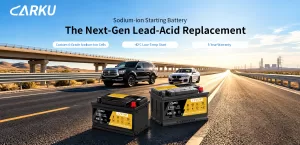
In automotive applications, Sodium-ion battery is not a mere lithium substitute. It delivers a seamless, “maintenance-free, drop-in replacement” experience reminiscent of traditional lead-acid batteries, but with lifespan and cold-cranking performance that far exceed them.
Is Na+ the Same as Sodium-ion?
In simple terms, Na+ is the working particle, while a Sodium-ion battery is the full energy storage system. In the automotive industry, especially during product inquiries or battery quotations, people often shorten “Sodium-ion starting battery” to “Na+ starting battery” for convenience. In most cases, both terms refer to the same type of Sodium-ion automotive starting battery.
Table info:Na+ vs Sodium-ion
| Term | Meaning |
| Na+ | A single positively charged sodium ion |
| Sodium-ion | A complete battery system using Na+ chemistry |
How Do Sodium-ion Batteries Work?
Sodium-ion batteries work by moving Na+ ions between the cathode and anode to store and release energy. When the vehicle needs to start, billions of Na+ ions rapidly flow through the battery within milliseconds, generating a powerful burst of current to crank the engine.
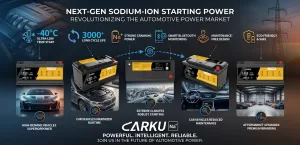
Unlike traditional lead-acid batteries that lose efficiency in freezing temperatures, Sodium-ion batteries use low-temperature-resistant electrolytes that help Na+ ions remain highly active even at -40°C, delivering more reliable winter starting performance.
Key Advantages of Sodium-ion Batteries for Automotive Applications
By utilizing the unique property of Na+ ions moving through hard carbon structures, Sodium-ion batteries unlock exceptional physical benefits:
Extreme Frost Resistance: Unlike traditional lead-acid batteries that freeze up, Na+ ions remain highly active in extreme cold, delivering strong cranking current even at -40℃.
Revolutionary Weight Reduction: Sodium-ion architecture allows for a incredibly lightweight design, cutting the weight by up to 50% compared to heavy, lead-filled conventional automotive batteries.

FAQs
Q1: Why Sodium-ion batteries perform better in cold weather?
Sodium-ion batteries maintain more stable energy transfer in low temperatures than many lead-acid and lithium-based batteries. Their Na+ chemistry helps reduce power loss in freezing conditions, while some automotive models also use intelligent self-heating systems for improved winter starting performance.
Q2: Is a Sodium-ion battery safe for automotive use?
Yes. Sodium-ion chemistry exhibits excellent thermal stability and is perfectly suited for high-current demands like engine starting and modern start-stop systems.
Q3: Why should cold-weather drivers switch to CARKU’s Sodium-ion series?
Engineered with cutting-edge Na+ technology, CARKU’s sodium-ion starting batteries deliver unmatched cold-cranking amps (CCA) and a dramatic 50% weight reduction. As a true maintenance-free, drop-in replacement, it seamlessly integrates with your vehicle’s application, ensuring reliable, frost-proof starts every single winter.
Understanding the distinction between microscopic Na+ ions and a complete Sodium-ion battery system is more than just a chemistry lesson—it is the key to unlocking a whole new level of automotive performance. While Na+ makes the low-temperature power possible on a molecular level, it is CARKU’s fully integrated system that brings this technology safely to your garage.
Say goodbye to heavy, dead winter batteries. Whether you are facing a -40℃ blizzard or looking to shed excess front-axle weight for better fuel efficiency, CARKU’s sodium-ion batteries are the smart, reliable choice for modern drivers. Experience the next-generation battery with CARKU.