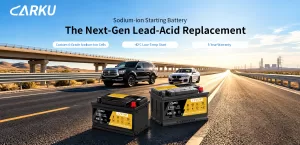

If you’ve been running your semi truck on a conventional AGM start-stop battery, you already know the cycle: replace it every 3–4 years, watch your maintenance bills climb, and hope it doesn’t fail on you in the middle of a harsh winter run. Upgrading your truck battery to CARKU’s sodium-ion solution breaks that cycle for good. Here’s everything you need to know before you make the switch.
Why the Upgrade Makes Sense Right Now
For fleet operators, idle time is not just “engine running time” — it is continuous cost leakage across every vehicle in operation.
Below is a breakdown of what one semi truck typically costs in a single year of idling operations.
Figure 1 — Annual Idle Cost Calculation
= $6,080 / year
Figure 2 — Maintenance Cost Accumulation
Even when the truck is not moving, idling still accelerates wear across key systems:
Maintenance Cost
| Item | Annual Cost |
|---|---|
| Engine Oil Changes | $1,200 |
| Fuel Filter Replacements | $1,089 |
| Air Filter Replacements | $1,200 |
| Total Maintenance | $3,489 |
Total Maintenance Load = $3,489 / year
Figure 3 — Hidden Regulatory & Aftertreatment Cost
DPF Cleaning ≈ $900 / year
From a fleet management perspective, this means:
- Every 10 trucks = ~$104,690/year in idle-related cost exposure
- Every 100 trucks = over $1M/year in avoidable operational loss
Even small efficiency improvements in starting and idle system stability directly scale into fleet-level cost reduction.
Idle time is not just fuel consumption — it is a compound cost system affecting fuel, maintenance cycles, and emissions treatment simultaneously. This is why fleet operators are increasingly evaluating more stable energy architectures such as sodium-ion starting systems like CARKU’s solution.
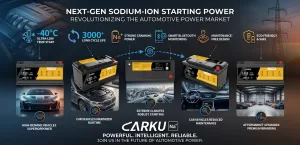
CARKU’s sodium-ion start-stop battery is built to hold that performance over time — delivering over 3x the cycle life of standard AGM batteries, so your start-stop system keeps working the way it was designed to.

What to Check Before You Upgrade Your Truck Battery
Before installation, run through these key checks to ensure a smooth transition:
- Confirm compatibility. Verify your truck’s start-stop system specifications and required battery voltage. CARKU’s sodium-ion batteries are engineered for heavy-duty big truck applications, but matching capacity ratings to your vehicle’s demands is essential.
- Inspect your existing electrical system. Worn cables, corroded terminals, or a failing alternator will undermine even the best battery. Address these issues before installation to protect your investment.
- Check for programming requirements. Many modern semi trucks require battery registration or ECU recalibration after a battery replacement. Confirm with your technician whether your truck model requires this step — skipping it can cause the charging system to behave incorrectly.
- Choose the right environment for installation. CARKU’s sealed, rugged design means it handles harsh, high-vibration environments by design — but initial installation should still be performed in a clean, dry workspace for best results.
What terminal do I hook up first when installing a Battrey?
For fleet maintenance teams and diesel technicians, battery replacement is a routine operation — but correct handling sequence and safety procedures still matter for minimizing risk and downtime.
STEP 1: Turn off ignition & isolate vehicle power
STEP 2: Disconnect OLD battery (negative terminal first)
STEP 3: Disconnect positive terminal
STEP 4: Remove old battery unit
STEP 5: Clean terminal corrosion and contact points
STEP 6: Install new CARKU sodium-ion battery
STEP 7: Connect positive terminal first
STEP 8: Connect negative terminal
STEP 9: Secure and test system
STEP 10: Press button, then turn on the ignition
The physical swap is straightforward for any qualified diesel technician. The old battery is removed, terminal contacts are cleaned, and the new CARKU sodium-ion starting battery is installed using standard heavy-duty battery mounting procedures.
Unlike traditional flooded lead-acid batteries, CARKU sodium-ion batteries are:
- Fully sealed construction
- No liquid electrolyte exposure risk
- Reduced corrosion and leakage concerns
- Safer handling during high-frequency fleet maintenance cycles
This makes them particularly suitable for high-utilization commercial fleets, where installation safety and speed directly impact operational uptime.
The Savings You Can Expect After the Switch
The financial case for upgrading is straightforward. A truck operating under standard US conditions with a fully functional start-stop system can recover up to $9,569 per year in combined fuel and maintenance savings — and up to $10,529 annually under high fuel price conditions. With CARKU’s sodium-ion battery maintaining start-stop performance across its extended lifespan, those savings compound year over year instead of eroding as the battery ages.
Factor in CARKU’s resilience at temperatures as low as -40°C — a condition where AGM batteries lose significant cranking power — and the value becomes even clearer for fleets operating in northern states like Minnesota, Wisconsin, or Alaska, where winter battery failures are a routine and costly headache.
In Conclusion
Upgrading your semi truck starting battery to CARKU’s sodium-ion solution isn’t just a maintenance decision — it’s a long-term cost strategy. With a longer cycle life, superior cold-weather performance, a fully sealed design built for heavy-duty punishment, and the potential to protect thousands of dollars in annual fuel and maintenance savings, CARKU represents a genuine step forward from conventional AGM technology.
The switch is straightforward. The savings are real. And the roads that used to break ordinary batteries won’t slow CARKU down.